
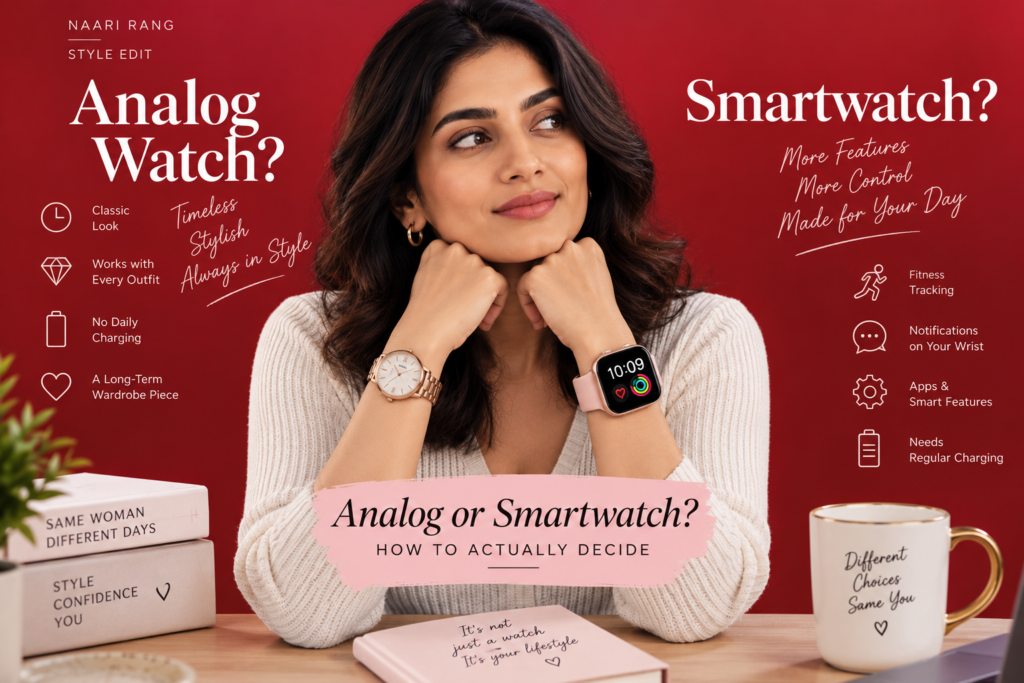
Quick answer: Choose a smartwatch if you genuinely want notifications, fitness tracking and other connected features on your wrist. Choose an analog watch if you want a simpler accessory that doesn’t need regular charging and can stay part of your wardrobe for years. The better choice depends less on how many features a watch has and more on what you actually want from it.
One important note if you’re considering Fossil: Fossil exited the smartwatch business in 2024 and no longer offers a current smartwatch range. Its current focus is on traditional watches, jewellery and leather goods. So if you’re specifically looking for a new Fossil watch, the decision is essentially about choosing an analog watch rather than a Fossil smartwatch.
Analog vs smartwatch: what’s the real difference
The easiest way to decide is to think about what role you want your watch to play.
Analog watches are primarily about time and style. An analog watch does one thing very well: it tells time while functioning as part of your outfit. There’s no screen to manage, no notifications competing for your attention, and no regular charging routine. A simple analog design can also move between workwear, casual clothing and festive dressing without looking tied to a particular technology trend. For someone building a capsule wardrobe, that longevity can be part of the appeal.
Smartwatches are primarily about information and convenience. A smartwatch adds functionality to your wrist. Depending on the model, that can include notifications, activity tracking, heart rate monitoring, sleep tracking, calls, apps and other connected features. The trade-off is that a smartwatch becomes another electronic device to maintain. You need to charge it regularly, keep its software supported, and eventually consider what happens when the hardware or software reaches the end of its useful life.
So the question isn’t simply which watch is better. It’s which set of trade-offs makes more sense for you.
A quick analog vs smartwatch comparison
| What matters | Analog watch | Smartwatch |
| Tells time | Yes | Yes |
| Notifications | No | Yes |
| Fitness tracking | No | Yes |
| Regular charging | No | Yes |
| Screen | Usually no | Usually yes |
| Outfit versatility | High with a simple design | Depends on design |
| Long-term technology support | Not software-dependent | Depends on manufacturer |
| Best for | Time, style and simplicity | Connected features and tracking |
Neither category is automatically better. The right choice depends on which features you’ll actually use.
Does Fossil make smartwatches
Not anymore. Fossil exited the smartwatch business in 2024. Its earlier range included touchscreen and hybrid models, but Fossil is no longer developing a current smartwatch line. That matters if you’re researching Fossil today, because older articles and retailer pages can still surface discontinued or outdated Fossil smartwatch models. If you’re specifically shopping for a new Fossil watch, focus on its current analog collections rather than assuming an older Gen 6 or hybrid listing represents a current product range.
Five questions to ask before choosing
1. Do you actually want notifications on your wrist? This sounds obvious, but it’s one of the most useful questions. If you’re constantly checking your phone anyway, having notifications appear on your wrist may be genuinely convenient. But if your goal is to reduce digital interruptions, adding another screen to your day may not help. Ask yourself: would wrist notifications make my day easier, or just give me another screen to check?
2. Do you want fitness tracking? If steps, workouts, heart rate data or sleep tracking matter to you, a smartwatch has a clear advantage over a traditional analog watch. But if you don’t use fitness tracking regularly, don’t buy a smartwatch simply because it has the capability. Features only add value when you actually use them.
3. Are you happy to charge your watch regularly? This is one of the biggest lifestyle differences. A smartwatch needs regular charging, with the exact frequency depending on the model and how you use it. An analog quartz watch doesn’t become part of your daily charging routine, since its battery lasts considerably longer than a smartwatch’s typical charge cycle, and mechanical watches don’t use a battery in the same way at all. If you want to put your watch on each morning without thinking about battery levels, analog has an obvious advantage.
4. Do you want a watch, or a small device on your wrist? An analog watch is primarily an accessory that tells time. A smartwatch is a connected device that also tells time. Neither is better, they simply serve different purposes. If you enjoy changing accessories to complement your clothes, a traditional watch can feel more like part of your wardrobe. If you want information immediately available without reaching for your phone, a smartwatch may be more useful.
5. How do you want your watch to fit into your wardrobe? For everyday styling, analog watches offer a lot of flexibility. A simple steel or leather watch can work with office clothing, jeans, kurtas, dresses and many festive outfits. A smartwatch can also work across different outfits, but the screen and case design can become more visually noticeable. If your priority is an accessory that blends into different looks, a relatively simple analog design is usually easier to style.
For more on building a polished wardrobe for work, see our guide to office wear for women.
What if you want some smart features but still like analog watches
A hybrid smartwatch can sit somewhere between the two. Hybrid models generally retain an analog-watch appearance while adding selected connected features, depending on the model. They’re worth considering if you like the appearance and simplicity of traditional watch hands but still want some tracking or notification functionality. That said, don’t assume every hybrid watch is currently supported simply because it appears in search results. Check whether the manufacturer still sells the model and supports its associated software before buying, which is particularly important when considering older Fossil hybrid models specifically.
When an analog watch makes more sense
An analog watch may be the better choice if you primarily want to tell time, don’t want regular charging, prefer accessories over screens, want one watch to work across multiple outfits, prefer classic or minimalist styling, don’t prioritise fitness tracking, want to keep the same watch for many years, or don’t want your watch generating additional notifications. For capsule-wardrobe shoppers, this can be especially appealing, since the watch becomes another repeatable accessory rather than another piece of technology to manage. Our upcoming guide to everyday watches that go with everything explores this side of the decision in more detail.
When a smartwatch makes more sense
A smartwatch may be the better choice if you want notifications without constantly checking your phone, fitness or activity tracking matters to you, you want health and activity data on your wrist, you use connected features regularly, you’re comfortable charging the watch as part of your routine, or you prefer having multiple functions in one device. If those features are central to why you’re buying a watch, choosing analog simply because it looks more timeless may leave you wishing you had bought the more functional option.
What about work and formal dressing
There isn’t one universal workplace rule. In conservative or client-facing environments, a simple analog watch can fit naturally with formal clothing. In relaxed, hybrid or creative workplaces, a smartwatch may be completely appropriate. It helps to think about the overall visual effect rather than treating one category as universally professional. If you’re wearing a formal blazer, tailored trousers and minimal jewellery, a simple analog watch reinforces that restrained look. With a more casual office outfit, either type can work depending on the design.
What about ethnic and festive outfits
Analog watches generally have an easier time blending into heavily accessorised outfits. A simple metal watch can sit alongside bangles, earrings and other jewellery without introducing another screen into the look. A smartwatch can still work with ethnic clothing, particularly if you prefer a contemporary or minimal style, but if the watch face is visually prominent, it may become another focal point alongside jewellery and embellishment. For someone who wants one watch to move easily from office wear to ethnic and festive dressing, a restrained analog design is usually the more straightforward choice.
Analog or smartwatch: quick decision checklist
Choose analog if most of these sound like you:
- I want a watch primarily for time and style
- I don’t want another device to charge
- I prefer classic accessories
- I want one watch to work with many outfits
- I don’t need fitness tracking
- I want something that isn’t dependent on software
Choose smartwatch if most of these sound like you:
- I want notifications on my wrist
- Fitness or activity tracking matters to me
- I want more functions than simply telling time
- I’m comfortable charging it regularly
- I already use connected devices heavily
- Convenience matters more to me than timeless styling
Questions before you decide
Does Fossil make smartwatches? No. Fossil exited the smartwatch business in 2024 and currently focuses on traditional watches, jewellery and leather goods. Older Fossil smartwatch listings may still appear online, so check a product’s current availability and support status before buying.
Is a smartwatch better for fitness tracking? Generally yes. Smartwatches are designed to provide activity and health-related tracking features that traditional analog watches don’t offer. That advantage only matters if you actually want and use those features.
Will an analog watch go out of style? A simple analog design can remain wearable for many years because its usefulness isn’t dependent on software updates or a particular technology platform. That doesn’t mean every analog watch is timeless. Trends in case size, colours and styling still change, so choosing a relatively simple design gives you a better chance of keeping it relevant across changing wardrobes.
Can I wear a smartwatch with ethnic or festive outfits? Yes, particularly when the overall look is contemporary. That said, a traditional analog watch with a restrained dial tends to blend more easily with jewellery and embellishment.
Should I buy a smartwatch just because it does more? Not necessarily. More features don’t automatically mean more value. If you won’t use notifications, fitness tracking or connected functions, the additional charging and device management may not be worth it. Choose based on your actual routine rather than the number of features listed on the box.
What is better for a capsule wardrobe, analog or smartwatch? For a capsule wardrobe focused on clothing and accessories, an analog watch is often easier to treat as a long-term styling piece, since a simple design can work across office, casual and festive outfits without being tied to a technology ecosystem. A smartwatch makes more sense if its tracking and connected features are an important part of your daily routine.
Making the call
Analog and smartwatches solve different problems. Choose a smartwatch when the technology is the reason you want the watch: notifications, fitness tracking, connected features and convenience. Choose an analog watch when you want it to function primarily as a long-term accessory: simple, easy to wear, low-maintenance and adaptable to different outfits.
If you’re specifically looking at Fossil, the decision is straightforward today. Fossil is no longer a smartwatch option, so its current offering is entirely analog, which means your next decision is really about style, size, strap and price point. If you’ve landed on analog, our guides to everyday watches that go with everything, Fossil watches for office wear, and Fossil watches under ₹10,000 go deeper into each of those, once they’re live.