
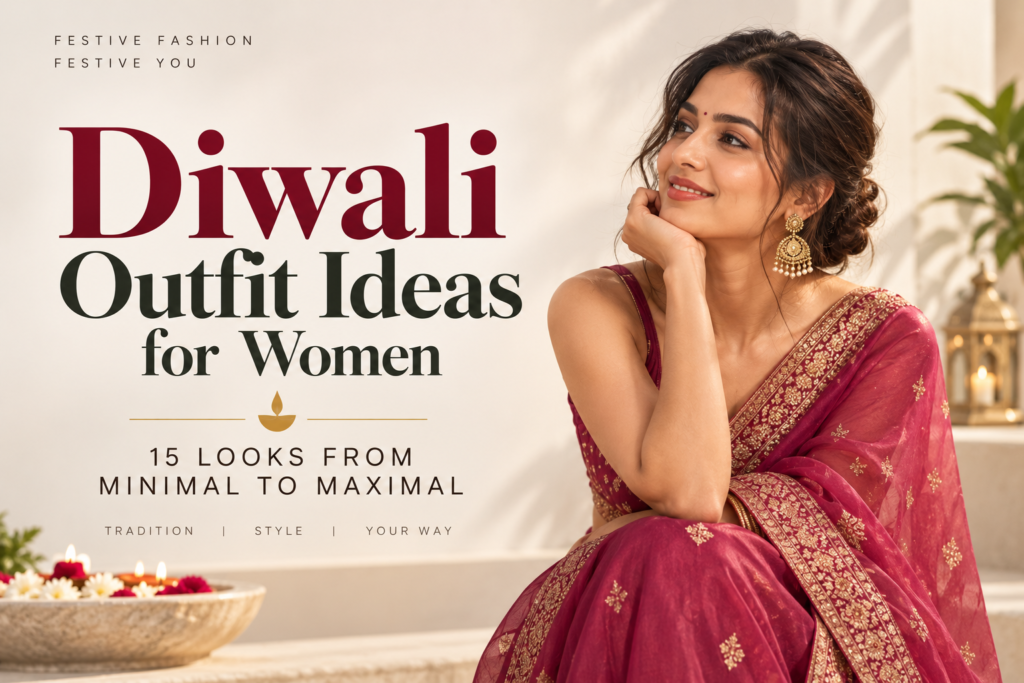
Quick answer: The best Diwali outfit depends less on how much you want to sparkle and more on where you’re going, how long you’ll be there, and what actually feels like you. These 15 ideas cover everything from understated daytime looks to full-on festive dressing.
Diwali dressing doesn’t have to mean automatically reaching for the heaviest lehenga in your wardrobe. Maybe you’re going to a morning puja. Maybe it’s a family dinner, an office party, or you’re hosting at home and want something festive but easy enough to move around in all evening. Instead of treating festive dressing as one fixed category, it helps to think of it as a spectrum: minimal, balanced or maximal.
First, decide what kind of Diwali you’re dressing for
Before choosing an outfit, it’s worth asking three things. Where are you actually going, since a home puja, an office party and a late-night celebration don’t need the same level of dressing. How long will you be wearing it, since heavy embroidery and elaborate layers look beautiful but can wear thin, literally, over several hours on your feet. And how festive do you actually want to feel, since you don’t need sequins head to toe to look dressed for the occasion. Silk, good jewellery, a beautiful dupatta or even one strong accessory can do the work on their own.
The minimal edit
For a daytime puja, an intimate family gathering, or anyone who prefers understated festive dressing.
1. A plain silk or silk-blend co-ord set. A matching kurta and palazzo in a rich jewel tone looks festive without a single stitch of embroidery. Let the fabric provide the shine and finish with gold or pearl jhumkas and comfortable flats. Formula: simple silhouette, rich fabric, statement earrings.
2. An unembellished cotton-silk saree. A solid saree with a subtle border is one of the easiest ways to look festive without feeling overdressed. Keep the blouse simple and let the saree do the work. Best for puja and daytime family gatherings.
3. A monochrome anarkali with minimal embroidery. One colour from neckline to hem, with embroidery kept to the neckline, cuffs or hem, gives a polished look without heavy embellishment. Style with statement earrings, a small clutch and neutral footwear.
4. A simple tissue or gold-shot kurta set. Let the fabric carry the festive weight rather than the silhouette. A tissue kurta or subtle metallic weave adds shine while everything else stays simple.
5. A simple saree with statement earrings. You don’t need an elaborate blouse and a dramatic drape at the same time. Keep the saree clean and let one strong accessory, oversized jhumkas or a sculptural pair of earrings, be the focal point.
The balanced edit
For an evening puja, a family dinner, a friend’s Diwali party, or anywhere you want to dress up without going fully maximal.
6. A lehenga with border-focused embroidery. Get the lehenga silhouette without the weight of all-over embellishment. Look for embroidery concentrated on the skirt border or blouse, and pair with a sleek hairstyle rather than heavy accessories.
7. A silk saree with a statement blouse. Keep the saree simple and let the blouse carry the drama, through embroidery, colour contrast or an interesting back. This also means you can swap the blouse later and get a different look from the same saree.
8. An indo-western cape set. A structured cape over trousers or a fitted inner layer gives you something visually different from the sarees and lehengas everyone else will be wearing. Best for house parties and more contemporary celebrations.
9. A simple suit with a statement dupatta. Pair a plain kurta and trouser set with a dupatta that has a bold border, print or embellishment. Formula: familiar outfit plus unexpected dupatta equals a new look, and it’s one of the easiest options if you already own basic ethnic pieces.
10. A draped gown with Indian jewellery. If traditional silhouettes aren’t your thing, a one-shoulder or draped gown still works for a contemporary Diwali party once you bring in jhumkas, bangles or a maang tikka.
Go maximal
For the main celebration, a big family event, hosting duties, or the years you want the full festive experience.
11. A fully embellished jewel-tone lehenga. Sequins, zari and detailed threadwork in deep green, wine, royal blue or plum create real drama. Keep the styling intentional rather than adding every accessory you own on top of it.
12. A Banarasi or Kanjeevaram silk saree. Some sarees don’t need much help. A richly woven Banarasi or Kanjeevaram carries colour, texture and craftsmanship on its own. Pair with jewellery that complements the weave rather than competing with it.
13. A heavily embroidered anarkali with a dupatta. For drama in a more covered silhouette, go for detailed work across the bodice and hem, then keep jewellery to one or two key pieces since the outfit is already doing most of the work.
14. A sharara set with a statement blouse. The volume and movement read as festive while feeling different from a conventional lehenga, and the wider silhouette photographs particularly well at evening celebrations.
15. A heavily embellished pre-draped saree. For the drama of a saree without managing pleats through a long evening, a pre-draped embellished option gets you there with less effort, ideal for parties and long receptions.
How to make a simple outfit feel more festive
You don’t necessarily need to buy something new. If your wardrobe already has a simple kurta, saree or co-ord set, changing just one or two elements often does the job: statement jhumkas, embellished flats or festive heels instead of everyday footwear, a contrasting dupatta, a metallic or embroidered clutch, a different blouse on a saree you already own, or a different drape altogether. Sometimes the gap between an everyday ethnic outfit and a Diwali outfit is simply styling. If you’re building toward fewer, more versatile pieces generally rather than a wardrobe full of one-occasion outfits, our guide to building a capsule wardrobe covers that approach in more depth.
Diwali outfit ideas by occasion
| Occasion | Outfit direction |
| Daytime puja | Cotton-silk saree, simple kurta set, minimal anarkali |
| Family gathering | Silk saree, anarkali, suit with statement dupatta |
| Office Diwali party | Co-ord set, contemporary suit, indo-western cape |
| Friends’ house party | Draped gown, sharara, contemporary lehenga |
| Big family celebration | Embellished lehenga, Banarasi saree, embroidered anarkali |
| Hosting at home | Comfortable silk set, saree with an easy drape, sharara set |
If sarees and lehengas aren’t your thing
You don’t have to wear either. A polished kurta set, a sharara, a cape set or a draped contemporary outfit can feel just as festive, usually by pairing one traditional element with one contemporary one, a straight kurta with statement earrings, or trousers with an embellished dupatta. Our upcoming guide dedicated to Diwali looks without a saree or lehenga goes much deeper into this specific question if that’s the direction you’re leaning.
The easiest way to choose
If you’re still staring at your wardrobe, use this shortcut. Want minimal? Pick one beautiful fabric and keep everything else simple. Want balanced? Pick one statement element, a blouse, a dupatta, or a piece of jewellery, and let the rest support it. Want maximal? Go for a dramatic silhouette and rich embellishment, but keep the accessories edited rather than piling on everything at once. Most importantly, choose something you can actually sit, eat, move and celebrate in comfortably. Diwali dressing doesn’t have to follow one formula, and the point isn’t to hit a specific level of festive, it’s to feel like yourself while doing it.
More festive outfit guides
If you’re planning looks across the whole festive season rather than just Diwali, our guides to Navratri colours and day-wise outfits, Karwa Chauth outfit ideas and what to wear for Ganesh Chaturthi cover the same ground for the festivals leading up to it. Browse more festive and everyday style guides in Style Edit.