
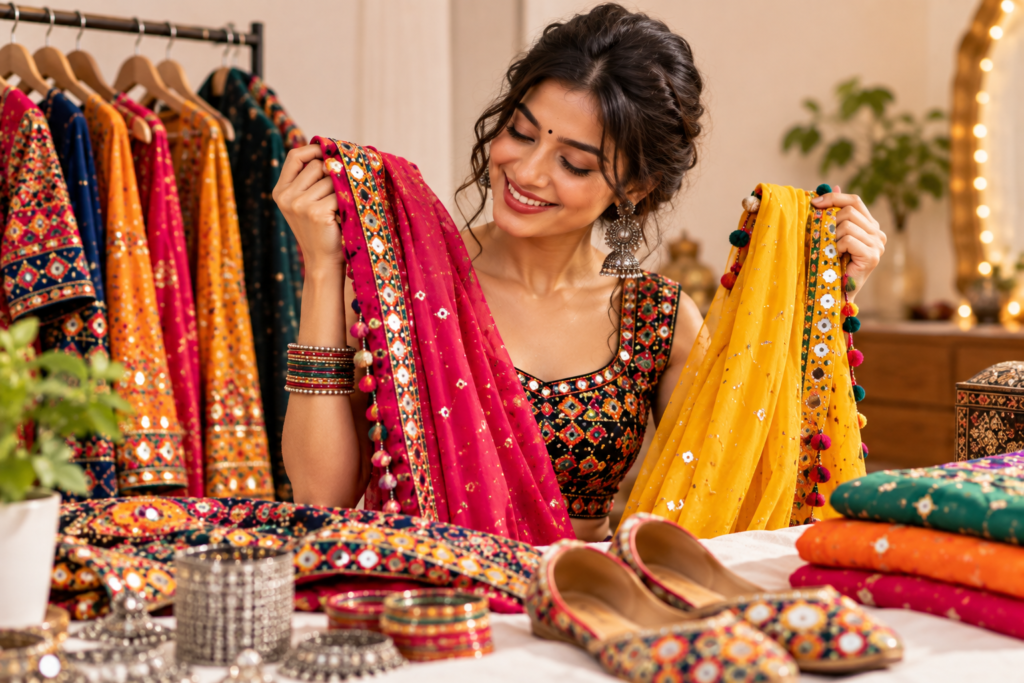
Sustainability has been part of the fashion conversation in India for a while now, and festive wear is where it’s arguably slowest to catch up, since occasion-wear culture leans heavily toward buying new for every event. That’s starting to shift a little. Here’s where sustainable choices actually fit into a Navratri wardrobe without turning the festival into a compromise.
Handloom and heritage craft: sustainable and not just a trend
Handloom textiles and regional crafts like Bandhani, Patola, and various forms of hand embroidery are inherently more sustainable than mass-produced synthetic alternatives, since they typically use natural fibres, support smaller-scale production, and last considerably longer with care. They also happen to be some of the most distinctive festive pieces you can wear, so the sustainability angle and the style angle aren’t in tension here.
The trade-off is usually price and care. Handloom and hand-embroidered pieces tend to cost more upfront and often need more careful washing or dry cleaning, but many are also things you’ll wear for years rather than one season.
Rework, rent, repeat: the lowest-effort sustainable choice
The most sustainable outfit for any given night is usually the one you already own. Reworking an existing piece with a new dupatta, different jewellery, or a different drape, as covered in our guide to reusing and reworking festive outfits, is also the simplest sustainable choice available, no new production involved at all.
Renting a heavier, occasion-specific piece for one or two nights rather than buying it outright reduces how much sits unused in a closet after the festival ends. This works especially well for elaborate lehengas that genuinely aren’t practical to rewear often.
Reading a “sustainable” label without getting greenwashed
Not every label that says “sustainable,” “eco-friendly,” or “conscious” backs that up with anything specific. A few things worth actually checking before trusting the claim:
- Does the listing name a specific material or process (organic cotton, natural dyes, handloom certification) rather than a vague word like “eco”?
- Is there any information about who made the piece and where, or is it a generic claim with no detail behind it?
- Does the price reflect the claim? Genuinely handloom or naturally dyed pieces are rarely priced the same as fast-fashion synthetic alternatives.
None of this needs to become an interrogation before every purchase, but a specific claim is worth more than a vague one.
Where this costs more, honestly
Sustainable and rental options aren’t always the cheaper route, and it’s worth being upfront about that. Handloom pieces often cost more than mass-produced equivalents. Rental has its own fees, and doesn’t always work out cheaper than owning something you’ll wear multiple times over several years. The value here is more about reducing waste and supporting different kinds of production than about saving money, though the two can overlap when you’re reworking or reusing what you already own.
Small swaps that add up
- Choose a natural fibre dupatta (cotton, silk, linen blends) over a synthetic one where the budget allows; it also tends to drape and photograph better.
- Buy separates you can genuinely wear again outside the festival, rather than a matched set that only works as one outfit.
- Pass along or resell outfits you’re not planning to rewear, rather than letting them sit unused.
FAQ
Is sustainable Navratri fashion more expensive?
Often, yes, particularly for handloom or naturally dyed pieces. The trade-off is usually longevity and craftsmanship rather than a lower price. Reworking what you already own remains the most budget-friendly sustainable option.
What makes a Navratri outfit more sustainable?
Natural fibres, handloom or heritage craft techniques, reworking existing pieces, and renting rather than buying single-use outfits are the main directions, rather than any single