
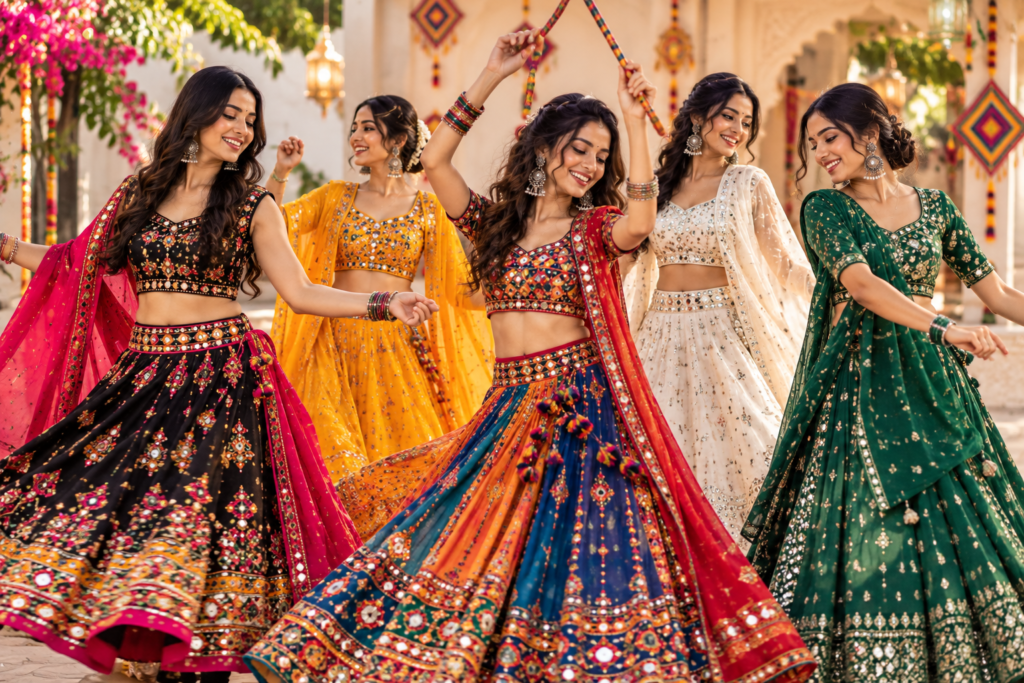
The lehenga hasn’t gone anywhere for Navratri, it’s the cut and construction that keep shifting. For 2026, the conversation feels less about maximum embellishment and more about movement, lighter construction, and pieces you can reasonably wear again. Here are seven styles worth knowing this year.
1. Classic panelled lehenga
What it is: Multiple fabric panels stitched together for a full flare, often with embroidery, mirror work, or traditional craft detailing.
Why choose it: The familiar full-skirted Navratri silhouette with plenty of room to move.
Best for: A traditional Garba look, or a particularly festive night like Ashtami or Navami.
2. Circular-cut lehenga
What it is: Built around a circular or near-circular cut, creating a smooth, generous flare.
Why choose it: More flow and movement than a heavily panelled skirt, with less bulk at the waist.
Best for: Anyone who plans to spend most of the night dancing.
3. A-line lehenga
What it is: A more controlled flare that starts closer to the waist and widens gradually toward the hem.
Why choose it: Cleaner and more versatile than a very full skirt, easier to dress up or down.
Best for: Readers who want one lehenga that works across multiple nights, formal and casual.
4. Tiered lehenga
What it is: Multiple horizontal layers build volume and movement without relying entirely on heavy embroidery.
Why choose it: A playful, voluminous look that still feels lighter than a densely embellished skirt.
Best for: A statement piece for one of the bigger nights.
5. Pre-draped or ready-to-style lehenga
What it is: The dupatta is pre-pleated, partially attached, or designed to fall into a set drape, cutting down how much pinning and adjusting you need to do.
Why choose it: Convenience, especially if you’re getting ready in a hurry or don’t want to redo the drape mid-event. Pairs well with the approach in our Garba styling guide.
Best for: Anyone prioritising ease over a fully customised drape.
6. Cape or jacket lehenga
What it is: A lehenga skirt paired with a cape or structured jacket instead of a traditional blouse.
Why choose it: A more contemporary, Indo-Western direction that photographs well without needing heavy jewellery to complete the look.
Best for: A fashion-forward take on the silhouette.
7. Co-ord lehenga set
What it is: A coordinated skirt and crop-top or blouse combination that can be worn together or separated later.
Why choose it: Each piece can be restyled outside the festival, which fits well with a budget-friendly festive wardrobe built around fewer, reusable pieces.
Best for: Anyone building a rotation across multiple nights rather than one standalone outfit.
Want something different? Dhoti-pant sets, shararas, and other contemporary co-ords are worth exploring if you want festive movement without a conventional lehenga silhouette.
| Lehenga style | Overall feel | Movement | Best for |
| Classic panelled | Traditional | High | Traditional Garba look |
| Circular-cut | Flowing | High | Dancing and twirling |
| A-line | Clean and versatile | Medium to high | Everyday festive styling |
| Tiered | Playful, voluminous | High | Statement look |
| Pre-draped | Convenient | High | Easy getting-ready |
| Cape or jacket | Contemporary | Medium | Fashion-forward look |
| Co-ord | Modern, versatile | High | Rewearing separates |
“Movement” here is an editorial styling read, not a measured fact, actual fabric weight, waistband, and cancan volume affect it just as much as the cut itself.
Whichever style you’re drawn to, how it actually suits your proportions matters more than where it sits on this list.
FAQ
Which lehenga style is easiest to dance in at Garba?
Look for a skirt with enough room for walking and spinning without excessive weight or layers. Circular, A-line, and lighter flared silhouettes tend to be practical choices, though the fabric, waistband, and amount of cancan matter just as much as the cut.
Which lehenga style should a first-time Navratri shopper choose?
A classic panelled, A-line, or circular lehenga can all be straightforward starting points, since they’re widely available and easy to style with different blouses and dupattas. Choose based on how much movement and volume you actually prefer rather than treating one cut as universally best.