
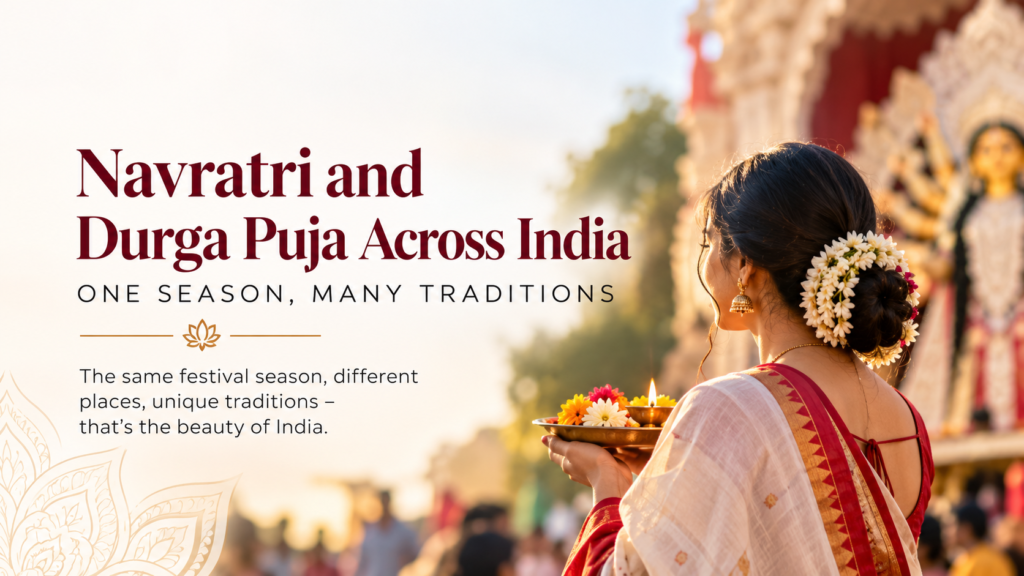
Sharad Navratri 2026 is observed from 11 to 19 October in the standard Navratri calendar, with Vijayadashami falling on 20 October in most of India. In Bengal, the Durga Puja panjika calendar (which decides each day by the tithi current at sunrise) places Vijaya Dashami a day later, on 21 October, since Dashami tithi doesn’t actually begin until midday on the 20th. It’s a small but genuine calendar difference worth knowing before you plan around it, and worth confirming against a local panchang if the exact date matters to you.
Beyond that starting point, almost everything about how these nine days are marked changes depending on where you are.
Navratri means “nine nights,” and across most of India it’s a period of fasting, prayer, and devotion to Goddess Durga in her nine forms. In West Bengal, Assam, Odisha, Jharkhand, Bihar and other eastern parts of India, the autumn festival period is closely associated with Durga Puja, whose principal public observance runs from Shashthi through Dashami. In Bengal specifically, Durga Puja is also called Sharadiya Pujo, Sharodotsab, or Maha Pujo, and it’s widely regarded as the state’s biggest and most prominent annual festival.
Move west to Gujarat and Maharashtra, and Navratri takes on strong community and devotional forms, with Garba and Dandiya especially prominent in Gujarat and increasingly visible in Maharashtra, alongside Ghatasthapana, fasting, and home worship. Head north, and Navratri sits alongside Ramlila performances leading up to Dussehra, with Kanya Puja (or Kanjak) widely observed, worshipping young girls as forms of the goddess. Go south, and the festival takes yet another shape: Golu (or Bommai Kolu) doll displays in Tamil Nadu, related doll-display traditions in Karnataka and parts of Andhra Pradesh, alongside Saraswati Puja and Ayudha Puja.
None of these is a variation of a single “correct” version, they’re distinct regional traditions within the same broader festival season.
A regional map
| Region | Main traditions |
| West Bengal and eastern India | Durga Puja, pandals, idol immersion, Shashthi through Dashami |
| Gujarat | Garba, Dandiya Raas, devotional gatherings, fasting |
| Maharashtra | Ghatasthapana, Durga worship, fasting, community celebrations, Garba/Dandiya in some areas |
| North India | Navratri worship, Ramlila, Kanya Puja/Kanjak, Dussehra |
| Tamil Nadu and parts of South India | Golu/Kolu, Saraswati Puja, Ayudha Puja |
| Telangana | Bathukamma, a distinct seasonal festival coinciding with the Navratri period |
| Himachal Pradesh, Karnataka | Kullu Dussehra and Mysuru Dasara, distinct named Dussehra traditions |
This list is deliberately broad. Practices vary further within each region, by community, family, and even individual household, so treat it as an entry point rather than a complete account of any single state’s traditions.
Why the same season looks so different
The story of Durga’s victory over Mahishasura is important across many regional traditions, but different parts of India place different emphasis on particular rituals, stories, and forms of worship. Bengal’s Durga Puja, Gujarat’s Garba culture, and South India’s Golu displays each developed along their own trajectories over centuries, shaped by local communities, history, and regional practice, rather than spreading outward from one point of origin.
This series looks at each region on its own terms:
- Durga Puja in Bengal: Pandals, Traditions and the Five Days That Matter Most
- Navratri in Gujarat: Garba, Dandiya and the Spirit of Nine Nights
- Navratri in Maharashtra: Ghatasthapana, Fasting and Family Traditions
- Durga Puja and Navratri in Bihar and Eastern India
- Navratri in North India: Ramlila, Kanya Pujan and Dussehra
- Navratri in South India: Golu, Bommai Kolu and Saraswati Puja
FAQ
Is Durga Puja the same as Navratri?
Not exactly. Navratri is a nine-night festival period observed in different forms across India, while Durga Puja is a specific tradition centred on the worship of Goddess Durga. In West Bengal and several eastern states, the principal public Durga Puja observance runs from Shashthi through Dashami, with elaborate pandals, idols, rituals, and immersion ceremonies. The two overlap in the autumn festival calendar, but they aren’t interchangeable terms.
Why do different states celebrate Navratri so differently?
Each region’s tradition developed along its own historical path, shaped by local communities and practice. Bengal’s Durga Puja, Gujarat’s Garba, and South India’s Golu are best understood as distinct traditions within the same festival season rather than variations of one original form.
Pingback: Navratri in Gujarat: Garba, Dandiya and the Spirit of Nine Nights - Naari Rang
Pingback: Navratri in South India: Golu, Bommai Kolu & Saraswati Puja - Naari Rang
Pingback: Durga Puja in Bihar, Jharkhand & Odisha: Regional Traditions - Naari Rang
Pingback: Navratri in North India: Ramlila, Kanya Pujan & Dussehra - Naari Rang