
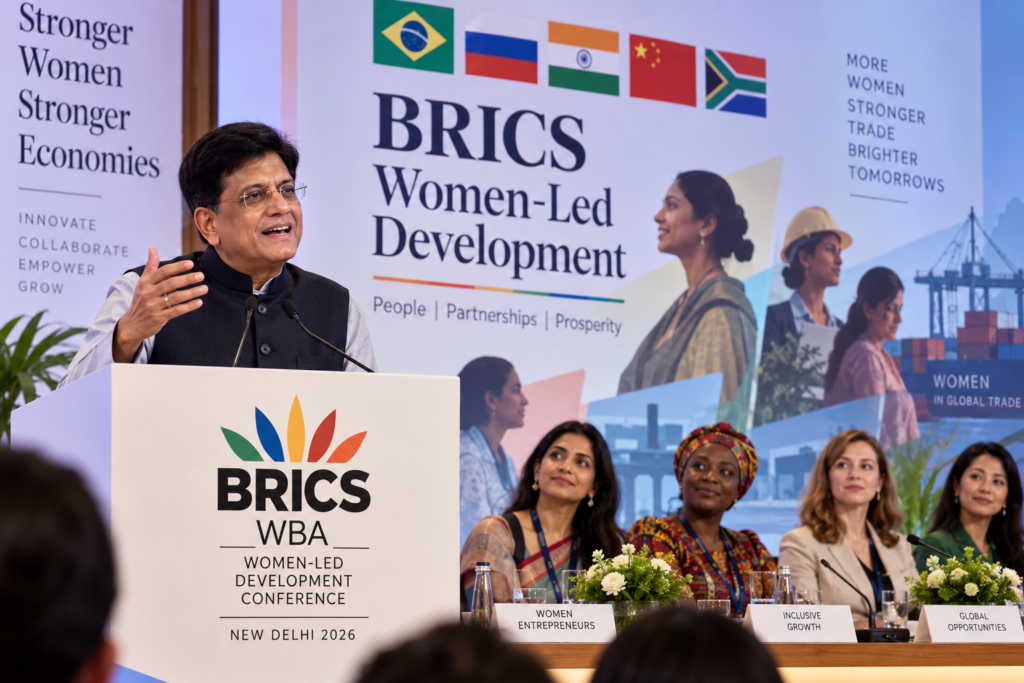
Union Minister of Commerce and Industry Piyush Goyal used a BRICS conference in Delhi on September 9 to make a specific case: that women entrepreneurs across BRICS countries need easier access to credit, buyers and markets, and predictable business rules before they can meaningfully enter global trade. He pointed to India’s own numbers on women’s financial inclusion as evidence of what’s possible, then proposed a set of steps for BRICS to take together. It’s worth being clear about what this speech actually was: not the announcement of a new scheme, but India’s existing track record used to argue for a set of proposals that are still just that, proposals.
What is a Lakhpati Didi
The term comes up often enough in this speech that it’s worth explaining plainly. A Lakhpati Didi is a woman, usually a member of a rural self-help group, who has reached a sustainable annual income of at least ₹1 lakh through livelihood or enterprise work. It’s part of the government’s DAY-NRLM rural livelihoods programme, not something new from this BRICS address.
Goyal said on September 9 that the number of women earning over ₹1 lakh personally had crossed 30 million. A separate 2026 government update put the more precise figure at 3.46 crore, about 34.6 million, women enabled as Lakhpati Didis. The two numbers come from different statements at different points in the year, so they’re best read as government-reported figures in the same range rather than a single precise count. Worth knowing too: the programme’s original target of 3 crore Lakhpati Didis was already met, and the government has since raised the goal to 6 crore.
The numbers behind the pitch
Beyond the Lakhpati Didi figure, Goyal laid out a broader picture of financial inclusion. About twelve years ago, he said, most women in rural India had no bank account, no assets in their own name, and no credit history, which meant most didn’t qualify for a loan at all. Since then, the government has opened close to 300 million bank accounts for women, put houses in women’s names, and extended collateral-free loans to women starting their own work, including those with no prior credit history. Of roughly 560 million small loans issued to entrepreneurs overall, Goyal said more than 68 percent went to women.
On workforce participation, Goyal noted that India’s female workforce participation stood at around 19 percent roughly a decade ago, and said he expects it to keep climbing toward 50 percent or higher as education, income and skills continue to improve, pointing to developed economies where women’s formal workforce participation already exceeds that mark.
On self-help groups specifically, Goyal cited around 100 million rural women in roughly 9 million groups. That’s broadly consistent with the wider DAY-NRLM programme, which separate government figures put at over 10 crore rural women organised into roughly 93 lakh self-help groups and their federations, suggesting Goyal’s numbers reflect the same underlying programme rather than a different or smaller one.
What India is actually asking BRICS for
This is the part that’s easy to mistake for finished policy. Goyal’s proposals to BRICS partners centred on three things, and none of them are operational yet.
First, a shared BRICS trade platform where a product requirement in one member country could become visible to entrepreneurs in another, with financial institutions able to participate directly in supporting women and small entrepreneurs through it. This builds on the Jaipur Consensus, reached at last month’s meeting of BRICS Commerce and Industry Ministers in Jaipur, where members agreed to explore such a platform and set voluntary principles for assessing small exporters beyond just invoices and payments. Second, turning the Women’s Advancement Fund raised in that same Jaipur Consensus into an actual, funded initiative, alongside recognising invoice-discounting as a lending signal for exporters who don’t have conventional collateral. Third, more sector-specific women-led trade delegations between BRICS countries, an all-women textile delegation was his example of the kind of initiative he wants to see more of.
He also pointed to India’s Government e-Marketplace as a working example closer to home: a platform that already encourages women-led enterprises to supply goods and services to the government, citing women entrepreneurs roughly 2,500 kilometres from Delhi supplying small consignments, sometimes worth as little as $100, directly to central government offices.
The bigger economic backdrop
Goyal tied all of this to India’s broader trade and growth numbers: merchandise exports up more than 15 percent between April and August despite global trade headwinds, and GDP growth of 7.8 percent in the April-to-June quarter, which he described as the highest growth rate of any major economy over that period. He also referenced India’s long-term target of growing from a $4 trillion economy to a $30 trillion one by 2047, framing women’s economic participation as central to reaching it. Closing the address, he quoted Prime Minister Narendra Modi’s line that “when women prosper, the world prospers.”
Why the framing matters
Most of what Goyal described, bank accounts, self-help groups, the Lakhpati Didi income threshold, are existing Indian schemes, not new announcements. What’s genuinely new here is India using that domestic record as leverage in a BRICS-wide conversation, arguing other member countries should build shared trade infrastructure rather than each working in isolation. Whether that turns into real outcomes, a funded Women’s Advancement Fund, an actual shared trade platform, depends on what happens at the BRICS Leaders’ Summit and beyond, not on this one address.
A few questions this raises
How many Lakhpati Didis are there in India? Government figures vary slightly by statement and date. Goyal said on September 9 that the number had crossed 30 million. A separate 2026 update put it at 3.46 crore, close to 34.6 million. Both are government-reported, not independently audited.
Is the BRICS common trade platform already running? No. Goyal described it as something BRICS countries have agreed to explore, not a system that’s currently operating.
What is a Lakhpati Didi, exactly? A woman, typically part of a rural self-help group, who earns a sustainable annual income of at least ₹1 lakh through livelihood or enterprise activities, as defined under the government’s DAY-NRLM programme.
What did Goyal actually propose, versus what already exists? The bank accounts, loans and self-help group numbers are existing programmes. The BRICS trade platform, the Women’s Advancement Fund, and the sector-specific trade delegations are proposals Goyal put forward for BRICS countries to develop, not things already in place.