
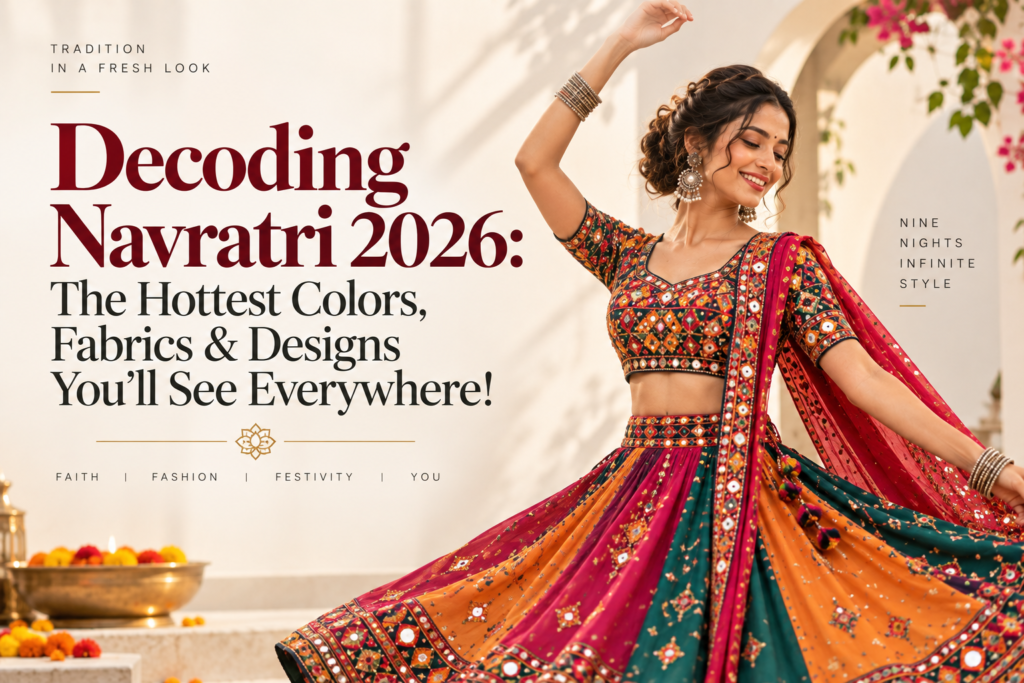
Sharad Navratri 2026 runs from Sunday, 11 October to Monday, 19 October, with Vijayadashami on 20 October. For anyone planning their festive wardrobe, this year’s nine nights bring the usual colour-coded dressing, plenty of Gujarati craft influence, mirror work, and some newer takes on the classic silhouettes.
Here’s what’s actually shaping Navratri fashion this year, starting with the colours.
The Navratri 2026 Colour Calendar
For 2026, the commonly followed nine day colour sequence begins with orange on Sunday and continues through white, red, royal blue, yellow, green, grey, purple and peacock green.
| Date (Oct 2026) | Day | Colour |
| 11 | Sunday | Orange |
| 12 | Monday | White |
| 13 | Tuesday | Red |
| 14 | Wednesday | Royal Blue |
| 15 | Thursday | Yellow |
| 16 | Friday | Green |
| 17 | Saturday | Grey |
| 18 | Sunday | Purple |
| 19 | Monday | Peacock Green |
This is the commonly followed 2026 calendar, but practices vary by region, community and family tradition. Durga Ashtami, Mahagauri Puja and Kanya Pujan timings especially are worth checking against a local panchang.
You don’t have to treat the day’s colour as a strict dress code. Many women follow it for Garba, Dandiya, work and festive gatherings, a habit that’s especially common in Maharashtra and Gujarat, while plenty of others just use it as a loose styling prompt.
Fashion directions to watch for Navratri 2026
There isn’t one single “official” trending fabric this year. A few directions do keep coming up in current festive fashion coverage though:
- Bandhani and Patola, reworked. This is the best supported trend of the lot. Gujarati craft techniques like Bandhani and Patola are turning up in newer cuts and colourways rather than only the traditional drapes.
- Mirror work on lighter fabrics. Kutch style mirror work is showing up on chiffon and organza more than on heavier cotton.
- Co-ord sets and separates. A cropped blouse paired with a flared skirt, restyled across different nights, is a practical way to avoid buying a full new lehenga for every occasion.
- Lighter festive layers. Chikankari and similar embroidery styles are being worked into pieces that feel less heavy and more wearable outside the festival too.
These are editorial reads on where festive fashion coverage is pointing right now, not a confirmed list from a single trend body, so it’s worth checking back closer to the season as new collections come out.
Styling notes
- Jewellery: Oxidised silver is popular for Garba nights, and some people lean toward temple jewellery for puja days. Neither is a rule.
- Footwear: Flat mojris or block heels tend to win out over height across nine nights of dancing.
- Dupatta: Often the cheapest way to refresh an old outfit. A Bandhani or mirror work dupatta can change how a plain set looks without a new purchase.
If you’re putting together a wardrobe for all nine nights rather than buying something new each time, a capsule approach works well: a few base pieces restyled with different dupattas and jewellery. It’s cheaper and easier to pack. And since festive spending tends to add up fast, it helps to plan the budget before the shopping starts, not after.
FAQ
What are the Navratri 2026 colours in order?
Orange, white, red, royal blue, yellow, green, grey, purple and peacock green, for 11 to 19 October 2026.
What are the biggest Navratri fashion trends for 2026?
Reworked Bandhani and other Indian crafts, mirror work details, co-ord sets and lighter festive layers are the directions worth watching for Navratri 2026.