
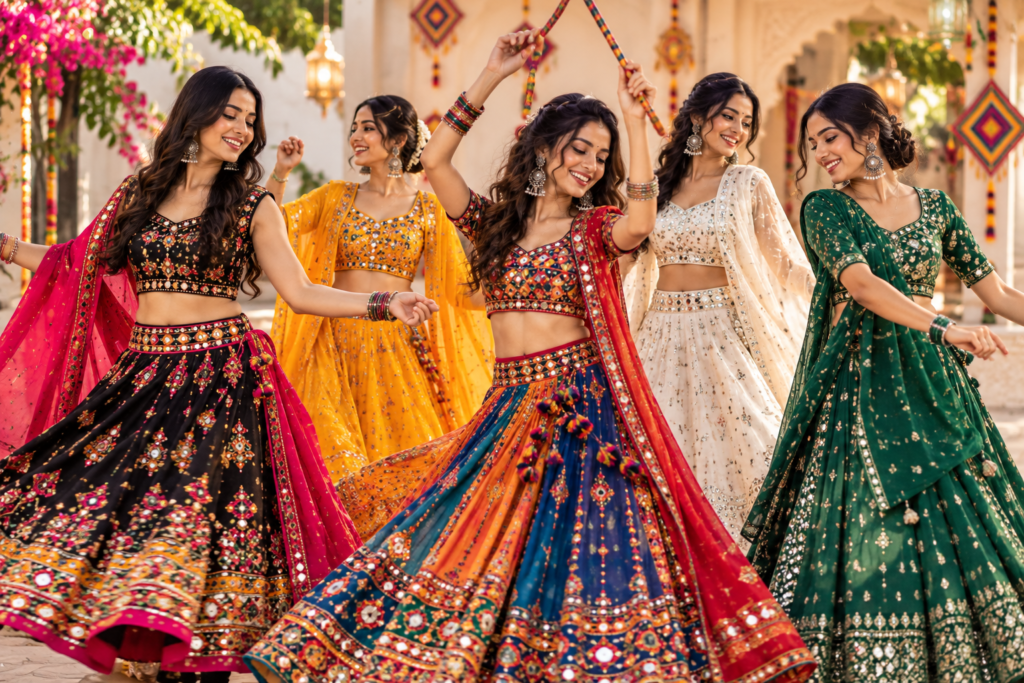
A chaniya choli or lehenga looks completely different depending on where the waistband sits, how full the skirt is, and how the blouse is cut. None of that is really about a “body type” label. It’s about proportion and personal preference, and once you know what you’re working with, choosing gets a lot easier.
You don’t have to identify with a particular body shape to use these suggestions. Treat them as styling options, not rules.
Read your proportions first
Skip the rigid body-shape charts. A faster way: stand in front of a mirror in something fitted and notice two things. Where does your waist sit relative to your hips and bust, roughly balanced, or is one noticeably fuller? And how long do your legs look relative to your torso? That’s really all the information you need for the choices below.
If your hips are fuller than your bust
If you’d like to visually balance fuller hips, try a fitted or semi-fitted blouse with an A-line or gently flared skirt. If you prefer more volume in the skirt, that’s absolutely an option too. The real goal is choosing the amount of volume you feel comfortable moving and dancing in, not avoiding volume altogether.
If your bust is fuller than your hips
A slightly longer blouse, ending at or just below the waist, is one option to explore alongside a fuller, more gathered skirt. A V-neck or sweetheart neckline can open up the neckline and give you another option beyond a high or heavily embellished one.
If your proportions are fairly balanced
There are plenty of silhouettes you can experiment with here, from fitted blouses and flared skirts to co-ord sets and more contemporary lehenga shapes.
If you’re petite
If you want a longer-looking silhouette, a higher waistline can be one option to try, and a blouse that ends around the waist can leave more visual space between the waist and hemline. Print scale is another variable worth playing with: smaller motifs tend to read as quieter, while larger motifs make the outfit feel more dramatic. Neither is more correct than the other.
If you’re taller
You can experiment with longer blouse lengths, fuller skirts, and lower dupatta drapes if you want to emphasise the length of the silhouette.
The blouse fit matters more than the size label
This is arguably the most useful thing in this whole guide. Your usual clothing size is only a starting point when buying or getting a Navratri blouse stitched. The actual fit depends on the garment’s measurements, its construction, and how much ease the design allows.
Pay particular attention to:
- Bust: the fabric should sit comfortably without pulling or gaping
- Shoulders: the shoulder seam should sit close to your natural shoulder point
- Armhole: you should be able to move your arms comfortably, especially if you’ll be dancing
- Waist: check whether the blouse is designed to sit at your natural waist or higher
- Closure: zips, hooks, ties and adjustable panels can affect how much flexibility you have
For a made-to-measure blouse, follow the seller’s measurement instructions rather than assuming your usual ready-to-wear size.
Choose for movement
A beautiful outfit that restricts your movement isn’t a great Garba outfit. Before committing to a silhouette, think about how much you’ll actually be walking, dancing, and sitting over the nine nights.
Check whether:
- the skirt allows comfortable steps and spins
- the blouse lets you raise your arms
- the dupatta stays secure while moving
- the waistband stays comfortable after several hours
- your footwear works with the actual hem length
Try the complete outfit together before the event rather than judging each piece on its own.
Once you’ve settled on a silhouette, our Navratri online shopping guide covers sizing, reviews and return policies before you order.
FAQ
What is the most flattering Navratri outfit for every body type?
There isn’t one universally flattering outfit. The best choice depends on the fit, proportions, movement, comfort and silhouette you personally prefer. A-line skirts, flared lehengas, different blouse lengths and adjustable waistlines all give you room to experiment.
Which lehenga is best for a shorter height?
A higher waistline, a blouse that ends around the waist, and a skirt with a clean, uninterrupted line can create a longer-looking silhouette. Print scale, colour and footwear also change the overall effect.
How should a Navratri blouse fit?
It should sit comfortably across the bust and shoulders without gaping, pulling or restricting arm movement. For a made-to-measure blouse, follow the seller’s measurement instructions rather than relying only on your usual clothing size.